


Client motivation makes or breaks your personal training business. The challenge isn't getting clients to start. It's keeping them going when results slow down, life gets busy, and initial excitement fades.
Understanding what drives your personal training clients changes how you approach every workout. Most trainers focus on exercise programming. The best trainers recognise that sustainable motivation comes from deeper psychological needs.
This guide shows you five evidence-based strategies to keep your fitness clients engaged, committed, and seeing results. You'll learn how Self-Determination Theory shapes client behaviour, why autonomy matters more than you think, and how to track progress in ways that actually motivate people.
These aren't generic motivation tips. They're practical techniques you can implement in your next training session to build stronger client relationships and reduce dropout rates.
Motivation isn't a single switch you flip on and off. It's a complex psychological state that shifts constantly based on how well you meet your clients' fundamental needs.
Your role extends beyond programming effective workouts. You're creating an environment where clients feel capable, autonomous, and connected. When these conditions exist, motivation becomes self-sustaining.
The problem with traditional personal training approaches is that they focus heavily on external rewards. "Lose 10 pounds, and you'll look great," or "Train hard to fit into those jeans." These tactics might work initially, but they rarely create lasting behaviour change.
Real motivation comes from within. It emerges when clients find genuine enjoyment in exercise, develop confidence in their abilities, and feel connected to their training goals. This is where psychological research becomes invaluable for personal trainers.
Self-Determination Theory provides the framework for understanding what motivates personal training clients at a fundamental level. Developed by psychologists Edward Deci and Richard Ryan, this theory identifies three basic psychological needs.
When you satisfy these needs, intrinsic motivation flourishes. When you neglect them, even the most disciplined clients struggle to maintain commitment.
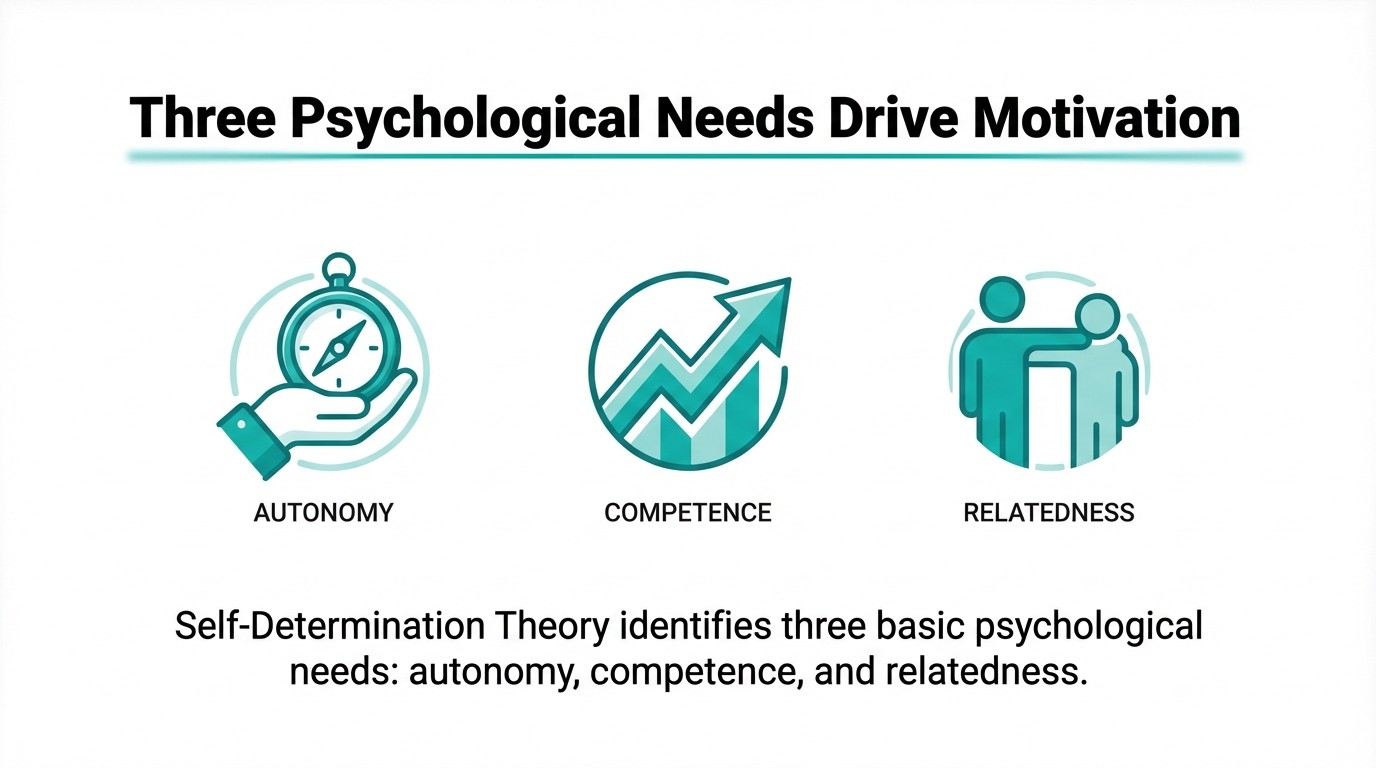
Autonomy means your clients feel they're choosing to exercise, not being forced into it. They feel a sense of ownership over their fitness journey. They make decisions about their training that align with their values.
Personal trainers who ignore autonomy create dependent relationships. Clients show up because you told them to, not because they genuinely want to improve. This dependency rarely survives life's inevitable disruptions.
Supporting autonomy doesn't mean abandoning your expertise. It means presenting options, explaining rationale, and helping clients understand why certain approaches work better than others.
Competence is about experiencing growth and mastery. Your clients need to feel they're getting better at something, whether that's lifting heavier weights, running longer distances, or simply moving with less pain.
Without regular competence feedback, motivation disappears. Clients lose confidence. They start believing fitness isn't for them. This is why tracking progress matters so much in personal training.
Every training session should include opportunities for clients to experience success. These wins don't need to be dramatic. Small improvements compound into significant confidence over time.
Relatedness refers to feeling understood, supported, and cared for by others. In personal training, this means building genuine relationships with your clients beyond just counting reps.
Clients who feel connected to their trainer stick around longer. They're more likely to communicate honestly about struggles. They show up even when motivation dips because they don't want to let you down.
This psychological foundation matters because it shifts your focus from external compliance to internal commitment. You're not trying to push clients through workouts. You're creating conditions that naturally encourage them to train.
Understanding the difference between intrinsic and extrinsic motivation helps you identify what truly drives each of your personal training clients. Both types have their place, but they function very differently.
Extrinsic motivation comes from external rewards or pressures. Your client trains to lose weight for a wedding, to avoid health problems, or because their doctor insisted. The motivation exists outside the activity itself.
Intrinsic motivation comes from within. Your client exercises because they genuinely enjoy how it feels, they love the challenge, or they find the process inherently rewarding. The activity itself provides satisfaction.
Research shows intrinsic motivation leads to better long-term adherence. Clients who are intrinsically motivated keep training even when external rewards disappear or lose importance. They've found something valuable in the exercise itself.

Most clients start with extrinsic goals. They want to look better, feel healthier, or meet someone else's expectations. Your job isn't to eliminate these motivations but to help clients discover intrinsic reasons alongside them.
Ask questions that reveal deeper connections to fitness. What did they enjoy about today's workout? When do they feel most capable during training? What aspects of getting stronger excite them beyond appearance changes?
These conversations help clients recognise the inherent value in exercise. They start to appreciate the process, not just chase outcomes. This shift dramatically improves long-term commitment to personal training.
Effective goal setting combines both outcome goals and process goals to maximise client adherence. Outcome goals provide direction. Process goals create daily satisfaction that sustains motivation when outcomes feel distant.
Autonomy support is one of the most powerful tools for motivating personal training clients. When clients feel they have genuine choices in their training, their internal motivation strengthens considerably.
This doesn't mean letting clients design their own programmes without guidance. It means involving them in decisions, explaining your reasoning, and offering options within your professional framework.
Start by offering workout variations. Instead of dictating exactly which exercises clients must perform, present two or three options that achieve similar training effects. Let them choose based on preference or how their body feels that day.
Explain the "why" behind your programming choices. When clients understand the rationale for specific exercises or training approaches, they feel more ownership over their fitness journey. They're making informed decisions, not blindly following orders.
Ask for input on workout structure. Some clients prefer to tackle difficult exercises first whilst they're fresh. Others need warm-up time before challenging movements. These preferences matter for both performance and psychological engagement.
Use autonomy-supportive language throughout training sessions. Instead of "You need to do three more sets," try "What do you think about completing three more sets?" This subtle shift acknowledges their agency in the process.
Create opportunities for clients to experiment within safe parameters. Let them adjust weights, try different tempos, or modify rest periods based on how they're feeling. This experimentation builds body awareness and strengthens internal motivation.
When designing long-term training programmes, involve clients in setting fitness goals that matter to them. Your expertise guides what's realistic and effective, but their input ensures the goals feel personally meaningful.
Tracking progress provides concrete evidence of competence development. Your clients need to see they're improving, not just believe they might be getting better. Data removes ambiguity.
Many personal training clients lose motivation because they can't recognise their progress. Changes happen gradually. Without measurement, improvements become invisible, and clients assume nothing's working.
Choose measurements that align with each client's primary fitness objectives. Weight-focused clients need body composition tracking. Strength-focused clients need load progression records. Wellness-focused clients might track sleep quality or energy levels.
Choose the Right Metrics for Each Client Goal
Tracking the right metrics keeps clients motivated and helps you personalise their journey. Here’s a quick guide to what you should measure, and how often:

Reduce barriers to exercise by making progress tracking simple and accessible. According to BJ Fogg's Behavior Model, when motivation dips, reducing difficulty improves adherence. Easy tracking systems keep clients engaged even during challenging periods.
Record every workout in detail. Log weights, sets, reps, and how the client felt during each exercise. This historical data becomes incredibly motivating when clients review how far they've progressed over months.
Show clients their progress regularly. Don't wait for them to ask. Schedule monthly review sessions where you walk through their data together, celebrating improvements and identifying areas needing adjustment.
Use visual progress representations whenever possible. Graphs showing strength gains over time or photos demonstrating changes in body composition create powerful psychological reinforcement. Visual evidence strengthens belief in the training process.
Consider having clients record training results themselves. This involvement increases ownership and helps them recognise patterns in their performance that might otherwise go unnoticed.
How you deliver feedback dramatically affects client motivation. The same information can either strengthen confidence or undermine it, depending entirely on your approach.
Positive reinforcement is more effective than criticism for maintaining motivation in personal training. This doesn't mean avoiding corrections or pretending poor form looks good. It means framing feedback in ways that build competence rather than highlighting inadequacy.
Catch clients doing things right and acknowledge it immediately. When someone completes a challenging set with excellent form, point it out. When they push through discomfort appropriately, they recognise their effort. These moments build confidence.
Frame corrections as opportunities for improvement rather than failures. Instead of "You're doing that wrong," try "Let's adjust your position slightly to make this more effective." The information is identical, but the psychological impact differs enormously.
Provide specific, actionable feedback rather than vague praise. "Great job" feels nice, but doesn't build competence. "Your squat depth improved significantly this month," or "Your core stability during that plank was excellent," reinforces specific capabilities.
Celebrate effort and progress, not just outcomes. Clients don't always control results, but they control their commitment and consistency. Recognising these qualities reinforces behaviours that lead to long-term success in fitness.
Use the feedback sandwich strategically but authentically. Start with a genuine positive observation, provide necessary correction or challenge, and end with encouragement. This structure maintains motivation whilst still pushing clients to improve.
Ask clients to assess their own performance before offering your perspective. "How did that set feel?" or "What do you think you could improve?" This approach develops their internal feedback mechanisms and strengthens autonomy.
Remember that connecting with clients through thoughtful communication builds the trust necessary for feedback to land effectively and motivate continued effort.
Variety in workouts prevents boredom and sustains psychological engagement in the average personal training client. When every training session feels identical, even dedicated clients lose enthusiasm for exercise.
Programme variation also serves important physiological purposes. Different stimuli challenge muscles in new ways, promote continued adaptation, and reduce the risk of injury from repetitive stress. The psychological and physical benefits work together.
Creating exercise rituals provides structure whilst reducing decision fatigue and adding meaning to sustain engagement during low-energy periods. Rituals create predictability that feels comforting rather than boring.
Vary training variables systematically rather than randomly. Change rep ranges, tempo, rest periods, exercise angles, or equipment whilst maintaining programme structure. This approach provides novelty without sacrificing progression.
Introduce new exercises gradually. Replace one or two movements each training cycle rather than overhauling entire programmes. This balance maintains familiarity whilst preventing staleness.
Use different training modalities strategically. Mix resistance training with bodyweight work, incorporate mobility sessions, add conditioning challenges, or include skill-based activities. Diverse fitness experiences keep clients mentally engaged.
Create themed workout weeks or special challenges periodically. A strength-focused week, a high-intensity week, or a movement quality week adds variety within your overall programme structure. These themes create anticipation and renewed focus.
Let clients influence variation by revisiting the autonomy principle. Ask what they'd like to try, what they've enjoyed recently, or what sounds challenging. Their input ensures variety aligns with personal preferences.
Balance novelty with progress tracking. Too much variation makes it difficult to measure improvement. Maintain core lifts or movements for several weeks whilst varying accessory work. This strategy provides both consistency and freshness.
Surface-level goals rarely sustain long-term motivation in personal training. "I want to lose weight" or "I need to get stronger" don't reveal what truly matters to your clients.
The deeper "why" behind fitness goals connects to identity, values, and the lives clients want to lead. Understanding this level of motivation transforms how you programme and communicate.
Ask "why" repeatedly during initial consultations and check-in conversations. When a client says they want to lose 20 pounds, ask why that matters. When they mention health concerns, explore what being healthier would enable them to do.
Listen for emotional connections to fitness goals. Does your client want strength to keep up with grandchildren? Energy to pursue career ambitions? Confidence to try activities they've always avoided? These emotional drivers sustain motivation when willpower fades.
Share your own genuine enthusiasm for fitness without imposing it on clients. Your passion can be contagious, but it needs to connect with their personal reasons for training. Help them find their own version of what makes exercise meaningful.
Revisit motivations regularly because they evolve. What mattered six months ago might not resonate now. New life circumstances create different priorities. Staying current with client motivations keeps your approach relevant and effective.
Connect daily workouts to bigger life goals explicitly. Remind clients how today's training session moves them towards what they really want. This connection prevents workouts from feeling like isolated obligations disconnected from their actual lives.
Document clients' motivations and refer to them during challenging moments. When a client struggles with motivation, reconnecting them to their deeper why often reignites commitment more effectively than any external incentive you could offer.
Building client-focused training around individual motivations rather than generic fitness goals creates personalised experiences that genuinely resonate with each person you train.
Understanding motivation theory is only valuable if you apply it consistently.
The five strategies in this guide aren’t one-off tactics. They’re habits you build into every session: offering choice, tracking meaningful progress, delivering confidence-building feedback, programming intelligent variety, and connecting training to what truly matters in your client’s life.
You don’t need to overhaul your entire coaching model overnight. Start with one area. Add more autonomy to your sessions this week. Improve how you track and review progress next month. Layer these principles into your systems gradually.
The trainers who retain clients long term aren’t just great programmers. They create environments where clients feel capable, in control, and genuinely supported. When autonomy, competence, and relatedness are built into your process, motivation stops being something you chase — and becomes something your clients sustain.
If you want to implement these strategies efficiently, your systems matter. PT Distinction gives you the tools to track progress clearly, communicate consistently, and deliver structured, motivating programmes at scale.
Start your free trial today and build a coaching experience that keeps clients engaged for the long run.
Ready to join the family?
We'll get you up and running in no time. Start with our zero-risk free trial and build your personal training empire today.