

Sports-specific training is a method of physical conditioning that targets the exact movement patterns, energy systems, and muscle groups an athlete uses in their sport.
It applies the principle of specificity: the body adapts to the precise demands placed on it, so training that mirrors those demands produces the greatest transfer to competition.
A 2024 systematic review and meta-analysis of 35 studies involving 777 elite athletes found a large and significant overall effect of resistance training on sport-specific performance, with a standardized mean difference of 1.16, according to research published on PubMed Central. That is a large effect. It is not subtle.
Most trainers already know sport matters when building programs. The real opportunity is precision: knowing exactly which movement patterns, energy systems, and physical qualities a sport demands, and building every exercise around that.
This guide gives you a clear, practical framework for building sports-specific training programs that actually transfer to the field, court, or ice.
Sports-specific training is the deliberate design of a workout plan around the physical, neuromuscular, and metabolic demands of a particular sport and position. It goes beyond general fitness. A 400-meter sprinter and a defensive lineman both need speed and power, but their training programs look nothing alike because their sport demands are entirely different.
The core idea is transfer. Every exercise in a sports-specific training program should make an athlete better at their sport, not just fitter in a general sense. That means analyzing what the sport actually requires: the dominant energy system, movement patterns, force-production demands, and the positions from which an athlete works.
This is different from general strength and conditioning, which builds a broad physical base. Sports-specific training narrows the focus toward peak performance in one context. Both have a place in a well-structured program, and the best coaches know when to use each.
For trainers building effective online training programs, getting that distinction right is where good programming separates from average programming.
The principle of specificity holds that physiological adaptations are specific to the type, intensity, and pattern of training stimulus applied. Train explosively, and you develop explosive capacity. Train in the range of motion your sport demands, and neuromuscular coordination improves in exactly that range.
This is not abstract theory. It explains why a marathon runner doing heavy back squats will not automatically run faster without sport-specific carryover work. The strength is real, but the neuromuscular pathways for running economy need their own stimulus. Force production in the weight room transfers to the field only when training is designed to bridge that gap.
Plyometrics are one of the most direct applications of specificity. Depth jumps, bounding, and reactive drills train the stretch-shortening cycle in the same mechanical conditions athletes face during competition. That direct match between the training stimulus and the demands of the sport is exactly what the principle of specificity calls for. It is also why cookie-cutter programs fall short for athletes who need precision in their physical conditioning.
Sports-specific training looks different for each sport because movement patterns, energy systems, and physical demands vary. The following examples illustrate how the principle of specificity applies in practice.
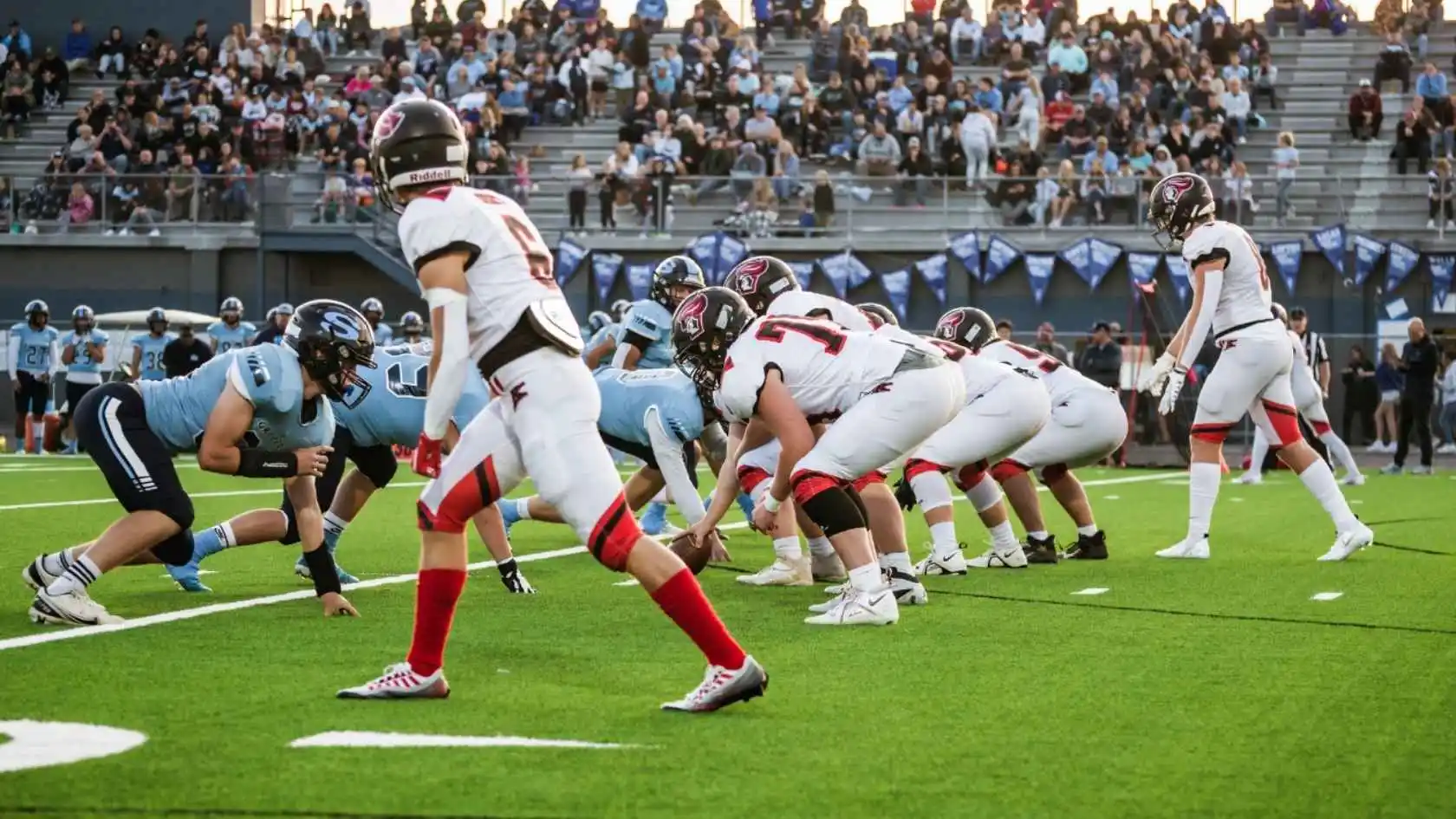
Linemen need maximal force production from a three-point stance. Their sports-specific training prioritizes heavy compound lifts, sled pushes, and short-burst plyometrics. Skill positions like wide receivers focus more on acceleration, change of direction, and reactive agility drills that match route-running patterns.
The sport runs on repeated short sprints, vertical jumps, and lateral cuts. A sport-specific training plan for a basketball player includes depth jumps for power development, lateral band walks for hip stability, and conditioning work that mirrors the stop-start aerobic demands of a 48-minute game.
Soccer players cover six to eight miles per game at varying intensities. Their conditioning demands span both aerobic and anaerobic energy systems. Sports-specific training for soccer combines repeated sprint protocols, single-leg strength work for injury prevention, and plyometrics to support the kicking and jumping actions of the game.
Rotational power is the defining physical quality. Pitchers and hitters both rely on force transfer through the kinetic chain, from the ground through the hips and into the upper body. Sports-specific training for baseball emphasizes anti-rotation core work, medicine-ball rotational throws, and shoulder-health programming to manage the high injury demands of overhead sports.
Skating mechanics demand strong hip abductors, single-leg stability, and the ability to repeatedly generate lateral force. Off-ice sports-specific training uses lateral sled drags, single-leg squats, and skating-specific plyometrics to build the strength and agility patterns that transfer directly to ice.
Court coverage, serve velocity, and recovery between points define tennis performance. A sports-specific workout plan for tennis players includes multi-directional agility work, rotational upper-body strength, and aerobic conditioning, structured around the work-to-rest ratios of actual match play.
The sports above share a common thread: they're built on running, repeated changes of direction, and multi-planar coordination, which place heavy demands on cardiorespiratory capacity and the lactate threshold, alongside strength and power. That's a completely different training focus from strength athletes, whose sport is the lift itself.
Powerlifters, weightlifters, and strongman competitors train primarily for maximal force production within a narrow, fixed range of motion, with far less emphasis on aerobic conditioning. Trainers who coach strength athletes online need a different programming lens built around that focus.
Sports-specific training produces benefits that general conditioning programs cannot replicate, because it targets the exact adaptations an athlete needs for their sport.
The most direct benefit is improved athletic performance on the field. When training mirrors the demands of competition, the neuromuscular coordination built in the gym transfers more efficiently. Athletes react faster, move more efficiently, and sustain peak performance for longer because their physical conditioning matches what the game asks of them.
Injury prevention is the second major benefit. Programming that strengthens the movement patterns and load tolerances specific to a sport reduces the vulnerability points that lead to overuse injuries.
ACL injuries among high school athletes grew 25.9% over 15 years from 2007 to 2022, reaching 7.3 injuries per 100,000 athlete exposures, according to Project Play’s injury analysis. That trend reflects what happens when athletes specialize hard without sport-specific physical preparation. Structured sports-specific training addresses these injury risks directly.
Return to sport after injury is also faster when athletes have built sport-specific physical conditioning before the injury occurred. Rehabilitation programs that incorporate sport-specific movement patterns from early stages re-establish neuromuscular coordination more quickly than generic rehab alone.
Power development, agility, and force production all improve when training is tied directly to sport mechanics. That is the core promise of sports-specific training: every adaptation earned in training has a direct application in competition. For trainers working with endurance athletes online, the same specificity principle applies to aerobic programming as it does to power-based sports.
Sports-specific training, general strength and conditioning, and functional training are related yet distinct approaches, each with different purposes in an athlete’s long-term development.
General strength and conditioning builds foundational physical capacity: maximal strength, aerobic base, structural resilience. It is the broad platform athletes need before sports-specific work can have its full effect. A weak athlete cannot translate sports-specific training into peak performance because the physical base is not there to support it.
Functional training sits between the two. High-intensity functional training showed a small-to-large effect size on improving upper- and lower-body strength, power, flexibility, and sport-specific performance.
A separate review found no significant difference between functional and regular training groups in overall athletic performance outcomes, as noted in this PubMed Central analysis. Functional training improves physical qualities broadly. It does not automatically transfer to sport-specific performance the way targeted sports-specific training does.
The smart approach uses all three in a periodized structure. Off-season phases emphasize general strength and conditioning. Pre-season shifts toward functional training and early sports-specific work. In-season training focuses tightly on sport-specific training to maintain peak performance without accumulating excessive fatigue. Getting the periodization right matters as much as the exercises themselves, and scheduling client workouts strategically is where that planning comes to life.
Three persistent myths about sports-specific training lead coaches to either misapply it or avoid it entirely, and all three are worth addressing directly.
Copying sport movements with weights is often counterproductive. A baseball player doing weighted bat swings changes the movement pattern in ways that can actually harm mechanics. True sports-specific training targets the physical qualities that support sports movements, not their imitation. Rotational medicine ball throws build the power a hitter needs. They do not mimic the swing itself.
Athletes still need general physical capacity. Strip out the strength-and-conditioning base, and sports-specific training loses much of its effect. The relationship is additive, not substitutive. A narrowly specialized athlete without foundational physical conditioning is fragile, not elite.
The evidence runs the other way. A longitudinal study found highly specialized youth athletes had 1.72 times greater odds of injury than low-specialized athletes and 1.52 times greater odds of overuse injury. Early specialization increases risk without consistently delivering the performance advantages it promises.
Sports-specific training is appropriate for athletes who have built a general physical base and are preparing for competition, but the timing and structure depend heavily on age and development stage.
For adult athletes at any level, sports-specific training can be incorporated year-round through a periodized approach. Recreational athletes benefit from lower volumes of sport-specific work than competitive athletes, but the principle of specificity still applies at every level of the game.
The picture is more complex. The Long-Term Athletic Development model holds that early specialization can be counterproductive, increasing the risk of injury and burnout. The NSCA defines early sport specialization as “intense year-round training in a specific sport with the exclusion of other sports at a young age,” and recommends against it for pre-adolescent athletes, according to NSCA’s guidance on youth specialization.
Nearly 1 in 10 youth athletes report burnout, and 70% quit organized sports by age 13, according to research published by the American Academy of Pediatrics. That is not a fringe issue. It is a structural problem in youth development.
The practical guidance is that children under 12 benefit most from multi-sport participation and general athletic development. Adolescents can begin introducing sport-specific physical conditioning progressively. Full sport-specific training programs are most appropriate for athletes in late adolescence and beyond, once the general athletic base is established.
Frequency depends on the athlete’s training age, sport season, and overall volume. During the pre-season, two to three sport-specific sessions per week alongside general conditioning is a common structure. In-season, one to two sessions maintain physical conditioning without adding recovery burden. Off-season shifts the balance toward general strength and conditioning.
No. General strength and conditioning provides the physical base that sports-specific training builds on. Athletes who skip general strength work in favor of only sport-specific methods tend to plateau sooner and face a higher risk of injury. The two approaches work together, not against each other.
Functional training improves broad physical qualities including strength, power, and movement efficiency. Sports-specific training targets the qualities specific to the demands of a particular sport. Functional training is a useful tool in a sports-specific program, but it is not the same thing.
General athletic development through multi-sport participation is the priority before adolescence. Structured sport-specific physical conditioning can be introduced progressively during the early teen years, with full sports-specific programming more appropriate from mid-adolescence onward. The research on early specialization consistently points toward more harm than benefit for younger athletes.
Start with a movement and energy system analysis of the sport. Identify the dominant movement patterns, the primary force production demands, and the conditioning requirements. Build the workout plan around those demands using a periodized structure. Track progress against sport-relevant performance markers, not just general fitness benchmarks.
If you are coaching athletes online and want to deliver sport-specific programs with precision, program delivery, progress tracking, and athlete communication all need to work together. That is exactly what PT Distinction is built for.
Start your free 1-Month trial and see how thousands of trainers worldwide use it to power their coaching, from program design to progress reporting, in one place.
Ready to join the family?
We'll get you up and running in no time. Start with our zero-risk free trial and build your personal training empire today.