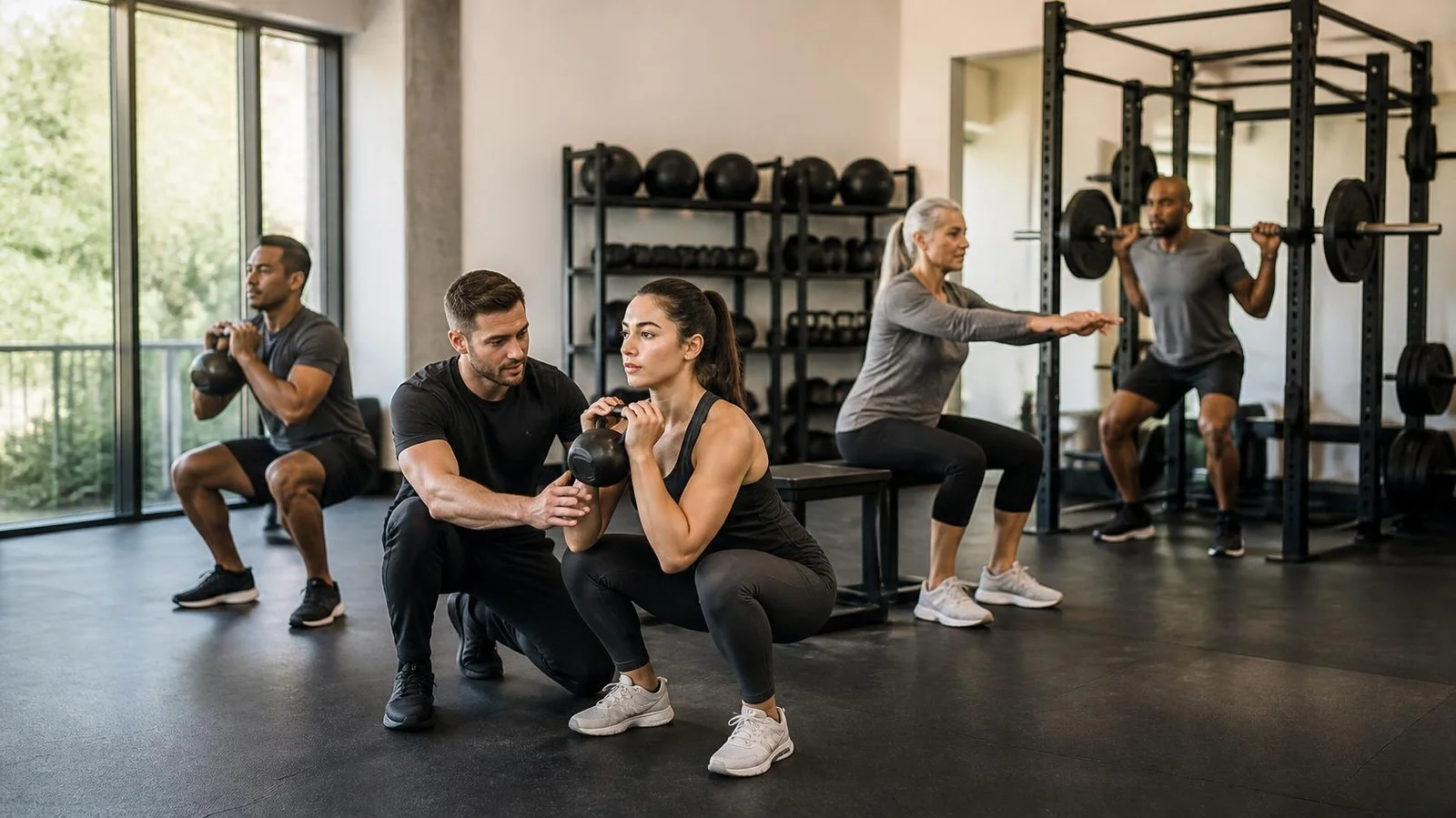


Once your diary is full of one-to-one sessions, you can only earn more by raising prices or working longer. Small group personal training gives you a third option. You coach two to six clients in the same session, each on a program adjusted for them, and charge each one less than one-to-one while earning more for the hour.
The catch is the word "personal." Small group training only works when you program once for the group and still coach every client individually. That depends far more on how you run the group than on the workouts themselves. When the program sits in a spreadsheet, the chat sits in WhatsApp and each client's adjustments sit in your head, the personal part is the first thing to slip.
PT Distinction is a personal trainer software platform that keeps the group program, each client's changes and the group chat in one place, so the personal part doesn't depend on your memory.
Small group personal training sits between a class and one-to-one coaching. The difference that matters is how much each client's program is individualized.
| Group fitness class | Small group personal training | One-to-one training | |
|---|---|---|---|
| Group size | Often 10 or more | Usually 2 to 6 | 1 |
| Programming | Same workout for everyone | Shared structure, adjusted per client | Fully individual |
| Coaching attention | Spread across the room | Regular individual cues and progressions | Constant |
| Price per client | Lowest | Lower than one-to-one | Highest |
| Your income per hour | Varies | Higher than one-to-one when groups are full | One client's fee |
If clients in your "small group" all do the same workout with no individual adjustments, it's a small class. That's a valid product, but it isn't what clients are paying a personal trainer for.
Small groups suit clients who want coaching but can't justify one-to-one prices, and clients who train better with company. Good fits include:
Groups work less well when one member needs close supervision for an injury or medical condition. Keep that client in one-to-one sessions until they're ready.
Decide the format before you sell it, so every member knows what they're signing up for.
The way to make small groups efficient is to write one program for the group and adjust it for each person, not to write four separate programs.
Build the shared session around movement patterns everyone can train, then set individual variations within it: a different squat variation for the client with a knee issue, heavier progressions for the client who's ahead, a regression for the newer member. Each client follows the same session structure, at the right level for them.
This is where most trainers' systems break. Keeping four copies of a program in sync by hand is slow, and it's easy to lose track of who had which adjustment. In PT Distinction, you build the program once in a group, schedule it for the whole group in one go, and then edit it for individual members. The client sees their own version in their app straight away, in place of the group version. See how PT Distinction Groups work.
Recording results is the other thing that slips in a group session. If you're writing everyone's weights on a clipboard, you're not watching technique. Give each client their program in their own app instead, and have them record their results after each set. The numbers stay accurate, and your attention stays on how each client is moving.
Run the same assessment you would for a one-to-one client before anyone joins a group. Screening, a movement assessment and a baseline for their goal tell you which variations each person needs from the first session, and give you something to measure progress against at the end of the block.
The intake and assessment steps in our guide to onboarding new personal training clients apply to group members too.
What happens between sessions is where small group training feels personal or doesn't. Two sessions a week is a small part of a client's week.
Running all of this in the same place as the program means you can see who trained, who logged their habits and who has gone quiet, without checking three apps.
Once a group format works, turn it into a package you can sell repeatedly: the block length, the program, the welcome information and the messages each member should receive.
PT Distinction lets you sell packages on your own website and add new clients to them automatically. Messages in a package are timed by days after joining, so a welcome message set for Day 0 arrives the moment a client pays, and follow-ups on Day 1, Day 7 or Day 30 go out on each client's own start date.
To fill a new group, you can run an automated free trial of the group program, and PT Distinction covers the cost of the trial accounts. Here's how to set up an automated pre-made package.
Most small group personal training sessions have two to six clients. Three or four is a good starting point: small enough to coach everyone individually and large enough that the session still runs if someone misses it.
Write one program for the group, built around movement patterns everyone can train, then adjust exercises, loads and progressions for each client. Assess every member first so you know which variations they need, and keep each client's version where they can see it, such as in their coaching app.
Price each place below your one-to-one rate, so the group is attractive to clients, while making sure the total for a full group is more than your one-to-one fee for the same hour. Selling a fixed block of weeks, paid upfront or monthly, gives you more predictable income than charging per session.
Yes. You build one program for the group, schedule it for every member at once, then edit it for individual clients. Group chat, leaderboards and packages sit alongside it, and every current feature is included on every plan. Start with a 1-month free trial.
Yes. Clients follow their version of the group program in an app, train on their own schedule or join a live session, and stay in touch through a group chat and individual check-ins.
Small groups grow your income per hour, as long as the admin doesn't grow with them.
PT Distinction runs groups, individual programs, check-ins, packages and payments in one place.
Every current feature is included on Basic, Pro and Master, so you choose a plan by client numbers and app branding, not by which tools your groups need.
Try it with your first group on a 1-month free trial.
Ready to join the family?
We'll get you up and running in no time. Start with our zero-risk free trial and build your personal training empire today.