


Postnatal fitness is the structured return to physical activity after giving birth, and getting it right matters more than most generic fitness advice acknowledges.
ACOG guidance recommends that new mothers aim for 20 to 30 minutes of physical activity per day, and women with a healthy pregnancy and normal vaginal delivery can start exercising soon after the baby is born.
Postpartum physical activity at that recommended level is associated with a 45% reduction in the risk of postpartum depression, a 37% reduction in urinary incontinence risk, and a 28% reduction in type 2 diabetes risk, per the 2025 Canadian postpartum guideline.
And yet, most new moms are handed a six-week clearance and left to figure it out themselves. That gap between clinical guidance and practical support is exactly what a well-built postnatal fitness plan is designed to close.
Postnatal fitness covers every form of intentional physical activity a woman undertakes from the day after giving birth through the full postpartum recovery period, typically the first year.
It addresses rebuilding strength, restoring pelvic floor function, supporting mental health, and returning to cardiovascular fitness at a pace the body can actually handle.
The stakes are real. ACOG committee opinion data show that women's participation in exercise programs diminishes significantly after childbirth, often contributing to overweight and obesity.
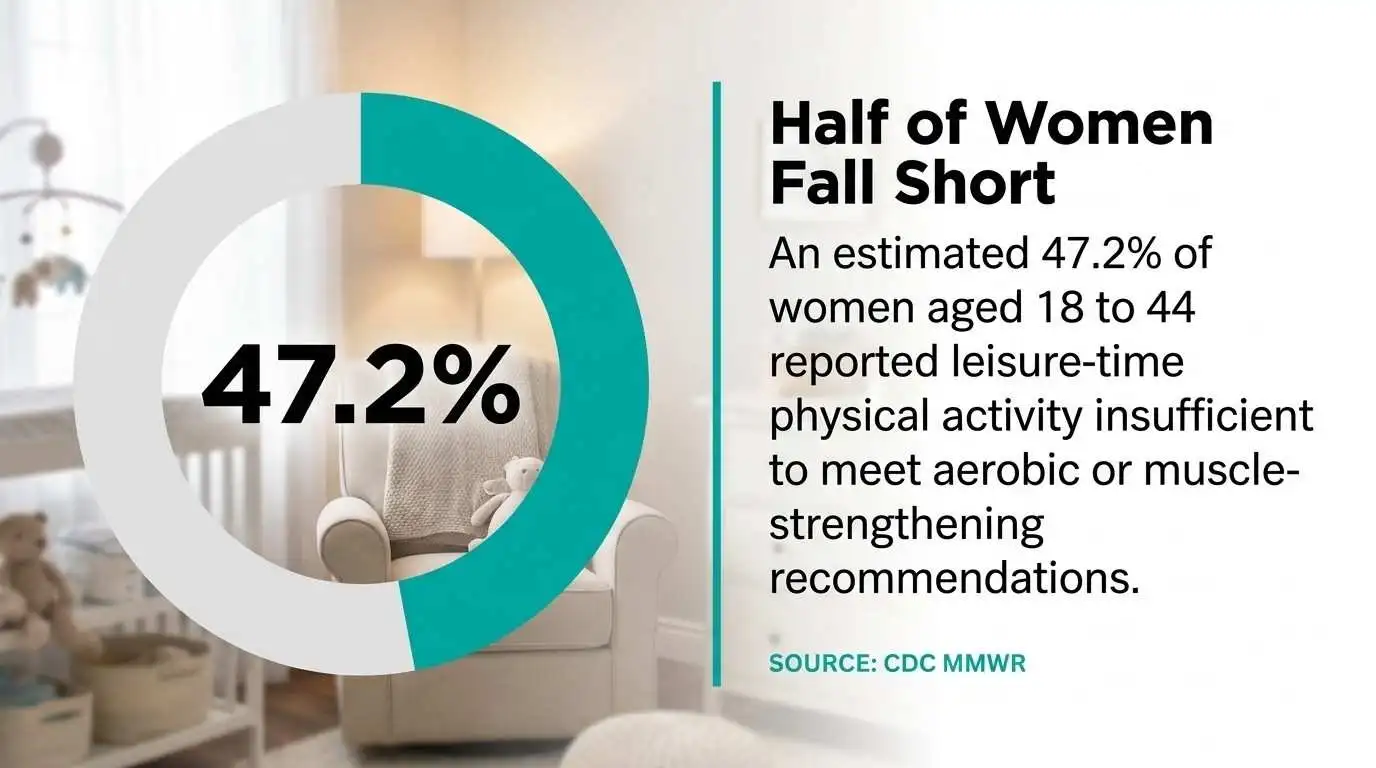
A national U.S. survey found that an estimated 47.2% of women aged 18 to 44 reported leisure-time physical activity insufficient to meet aerobic or muscle-strengthening recommendations, according to CDC survey data.
That number tells trainers something important: this population needs structured support, not just encouragement.
For trainers building structured workout plans for postpartum clients, understanding the physiological context is the starting point.
Pregnancy changes everything from hormone levels to joint laxity to posture. A postnatal fitness plan that ignores those changes is not a postnatal plan. It is just a generic workout with the wrong client in mind.
Postnatal exercise produces measurable physical and mental health benefits that go well beyond weight management, and trainers who frame it only as a body-composition tool are underselling their service.
The mental health case is particularly strong. Maternal mental health disorders, including postpartum depression, affect roughly 600,000 U.S. mothers each year, or about 20% of all new mothers, per GWU report data.
A JAMA Network Open analysis found the postpartum depression rate in the U.S. climbed from 9.4% in 2010 to 19.0% in 2021.
Exercise is not a treatment, but the protective association is meaningful: postpartum physical activity at recommended levels is linked to a 45% lower risk of postpartum depression developing in the first place.
The physical benefits reach further than most people realize. Beyond cardiovascular fitness and muscle tone, regular postnatal exercise reduces the risk of urinary incontinence and lowers the likelihood of developing type 2 diabetes.
For clients worried about breastfeeding, a randomized trial in Breastfeeding Medicine confirms that moderate-to-high-intensity exercise doesn't affect breast milk volume or its macronutrient content. That is worth sharing directly with clients who hesitate to train because they are nursing.
Build these benefits into every postnatal intake conversation. When a client understands what exercise does for her mood, continence, and energy, adherence becomes a different conversation entirely.
The timing of postnatal exercise after giving birth depends on delivery type, individual recovery, and the absence of complications, and no single timeline applies to every woman.
For vaginal delivery with no complications, ACOG guidance is clear: exercise can begin soon after birth. The 2025 Canadian Guideline takes a similarly individualized position, explicitly stating that “one size does not fit all” for postpartum exercise timing, and recommends progressing toward 120 minutes per week of moderate-to-vigorous intensity activity, per the BJSM postpartum guideline. That target is a destination, not a starting point.
Cesarean section recovery follows a different path. Abdominal muscles and core tissue are directly affected by the surgical procedure, and clients recovering from a C-section need longer before loading those structures. Don't assume six weeks means fully cleared for all movement after a C-section.
The 6-week postpartum check with a healthcare provider is a necessary gate, not an automatic green light.
ACOG guidance confirms pelvic floor exercises can begin immediately for women with an uncomplicated vaginal delivery; with a C-section and complicated deliveries, they need to be cleared by their medical team first.
A postpartum exercise timeline should move through four clear stages, with progression tied to physical readiness rather than the calendar alone.
This stage is about restoration, not training. Program pelvic floor exercises and gentle diaphragmatic breathing for most clients from day one.
For those with uncomplicated vaginal deliveries, you can introduce short, slow walks within the first week. The goal is circulation, not cardio. Keep sessions under 20 minutes, and have clients stop if they experience pain, pressure, or leaking.
You can advise the new mom to increase walking duration gradually and introduce light mobility work and posture exercises. Focus core rehab on the breath-to-movement connection rather than traditional abdominal exercises. Avoid programming anything that increases intra-abdominal pressure, including crunches, sit-ups, and heavy lifting.
Watch for signs of diastasis recti at this stage: a visible gap or doming along the midline of the abdomen during movement.
The 6-week postpartum check with a healthcare provider is the gateway to broader exercise. With clearance, clients can begin low-impact aerobic activity, bodyweight strength work, and more structured core exercises.
For C-section clients, this check is especially important before loading the abdomen. Referring a client to a pelvic floor physiotherapist at this stage is one of the most useful things a trainer can recommend.
By 12 to 16 weeks postpartum, most women with uncomplicated recoveries can begin progressing toward higher-intensity postnatal exercise, including strength training with load, low-impact interval work, and eventually a return to running if appropriate.
The prenatal-to-postnatal programming transition requires rethinking exercise selection at each stage. Trainers building this into a formal program will get far better client outcomes than those working session by session.
The best early postnatal exercises rebuild functional strength from the inside out, starting with breath and pelvic floor before adding any load or impact.
The five exercises below work across early postpartum recovery and can be progressed as fitness improves:
Cue the client to lie on her back with knees bent, then inhale to expand the ribcage and belly, then exhale fully. This reconnects the diaphragm and pelvic floor, the foundation of all postpartum core work.
Cue a contraction of the pelvic floor muscles, as if stopping the flow of urine, hold for 5 to 10 seconds, then fully release. Emphasize the release as much as the squeeze. Start with 10 repetitions, three times per day.
Have the client lie on her back with feet flat, hip-width apart, then drive through the heels to lift the hips, pause at the top, and lower slowly. This activates the glutes and posterior chain without loading the abdomen.
Once the 6-week postpartum check has cleared her for standing exercise, add squats to rebuild lower body strength and reinforce the functional movement patterns she uses constantly with a newborn.
Program short, consistent walks with cues on posture, heel strike, and breathing cadence. This does more for early postnatal fitness than any high-intensity session attempted too soon.
Trainers looking at how to balance pre-built and tailored sessions for this population will find the pre-made vs. bespoke debate worth considering. With postnatal clients, the case for bespoke is strong. Delivery type, diastasis recti status, pelvic floor function, and sleep deprivation all vary enormously between individuals.
Pelvic floor recovery is the non-negotiable starting point for any postnatal fitness plan, because pelvic floor dysfunction affects a large proportion of postpartum women and undermines every other training goal if left unaddressed.
Frontiers pelvic floor research found that between six weeks and one year postpartum, the weighted mean prevalence of urinary incontinence is 31%, ranging from 10% to 63% across studies.
For context: that means roughly one in three postpartum women is dealing with urinary leakage during the period when they are most likely to return to exercise. If a trainer does not screen for this, they will design a program that makes it worse.
Pelvic floor exercises can and should begin in the immediate postpartum period. The key is teaching clients the difference between a contraction and a release.
Most women can identify the squeeze, but the full relaxation at the end of each repetition is equally important for muscle function and for avoiding hypertonic (overly tight) pelvic floor patterns.
Signs that a pelvic floor referral is needed before progressing postnatal exercise include: leaking with impact, pressure or heaviness in the pelvic region, pain with movement, or difficulty controlling urgency.
These are not obstacles to training. They are red flags that require a pelvic health physiotherapist, and a good trainer knows when to refer.
Core rehabilitation after giving birth requires a fundamentally different approach from standard abdominal training, because the abdominal muscles have been stretched and reorganized during pregnancy in ways that take months to recover.
Diastasis recti, the separation of the rectus abdominis along the linea alba, occurs to some degree in most pregnancies.
It is not automatically a problem, but it becomes one when trainers use exercises that increase intra-abdominal pressure before the connective tissue has regained sufficient tension. Crunches, sit-ups, leg raises, and heavy loaded movements are contraindicated until diastasis recti has been properly assessed and the client has been cleared to progress.
A simple self-check for diastasis recti: lie on the back, place two fingers horizontally across the midline at the navel, and lift the head slightly. A gap of more than two finger-widths, or a visible ridge of tissue, warrants referral for assessment before loading the core. Diagnosing diastasis recti isn't a trainer's role, but knowing when to send a client to a specialist is.
PT Distinction's built-in Assessments feature lets you log pelvic floor function, diastasis recti measurements, and movement screen results at each check-in, so you have a clear, timestamped record of how each client is progressing through recovery.
Core rehabilitation for postpartum clients in early recovery follows this sequence: breath work first, then pelvic floor activation, then deep core engagement (transverse abdominis), then movement integration. Functional fitness programming maps directly onto this model. The goal is to restore the core's capacity to transfer force during everyday movement, not build a six-pack.
A national prospective cohort study found that postpartum weight retention in the U.S. is approximately 75%, according to ScienceDirect cohort data. That statistic matters here because it reflects how many women enter postnatal fitness programs with weight management as a goal.
Core rehabilitation is often the foundation that lets them train without injury, which in turn supports sustained activity and healthy weight outcomes. Frame it that way with clients who are impatient to do "real" ab work.
Postnatal exercise safety depends on trainers and clients both knowing the warning signs that require stopping activity and seeking medical review, because pushing through postpartum symptoms is one of the most common and harmful mistakes in this population.
Instruct the client to stop exercise immediately and contact a healthcare provider if any of the following occur during or after postnatal exercise:
Breastfeeding adds one practical consideration. Exercise does not reduce milk supply at moderate intensities, but dehydration can. Advise breastfeeding clients to hydrate before, during, and after sessions, and to feed before a workout to make intense movement more comfortable.
The most commonly reported barriers to postnatal physical activity at both 3 and 12 months postpartum are lack of time and childcare, per PubMed’s research on barriers.
Trainers who acknowledge this upfront and build short, home-based sessions into the early phases of a postnatal plan will get far better adherence than those who design gym-dependent programs that assume unlimited availability.
PT Distinction's Habits feature lets you assign daily pelvic floor exercises and short walks as trackable habits, so clients complete the work between sessions without relying on willpower alone. Automated reminders increase adherence by over 90%.
PMC postpartum planning research makes clear that as a fitness professional, you must account for both physical and mental health factors when designing a safe program for new moms.
A client managing sleep deprivation, postpartum depression, or a difficult recovery needs a trainer who asks the right questions, not one who just hands over a generic postpartum template and expects 100% adherence.
For trainers thinking about how to structure and deliver postnatal programs efficiently across multiple clients, the weekly workout planner approach gives a useful framework for building sessions that can be adapted without starting from scratch every time.
PT Distinction's AI Program Builder lets you generate a stage-specific postnatal training program in under 20 seconds — then adapt it to each client's delivery type, diastasis recti status, and current capacity. Build once, personalize fast.
Postnatal fitness is one of the most clinically sensitive areas a personal trainer works in. Done well, it changes outcomes for clients at a genuinely vulnerable point in their lives. Done badly, it sets back recovery by weeks or months. The plan has to be built on physiology, not assumption, and progressed on readiness, not a fixed calendar.
If you work with postpartum clients online, the challenge isn't just programming. It is delivering a program that adapts as the client does, communicating around a chaotic schedule, and tracking progress that is often non-linear.
PT Distinction gives you the tools to do all of that in one place: structured program delivery, habit and progress tracking, and client communication that keeps the coaching relationship strong between sessions.
Start your free 1-Month trial and see how trainers worldwide are delivering postnatal fitness programs that actually stick.
Ready to join the family?
We'll get you up and running in no time. Start with our zero-risk free trial and build your personal training empire today.