Functional fitness training is a method of exercise that trains the body to perform everyday movements more efficiently, using multi-joint, compound movements that mirror real-life tasks like lifting, carrying, bending, pushing, and pulling.
Unlike isolation exercises that target a single muscle in a controlled machine, functional training recruits multiple muscle groups simultaneously, building the kind of strength, balance, and coordination that actually transfers outside the gym.
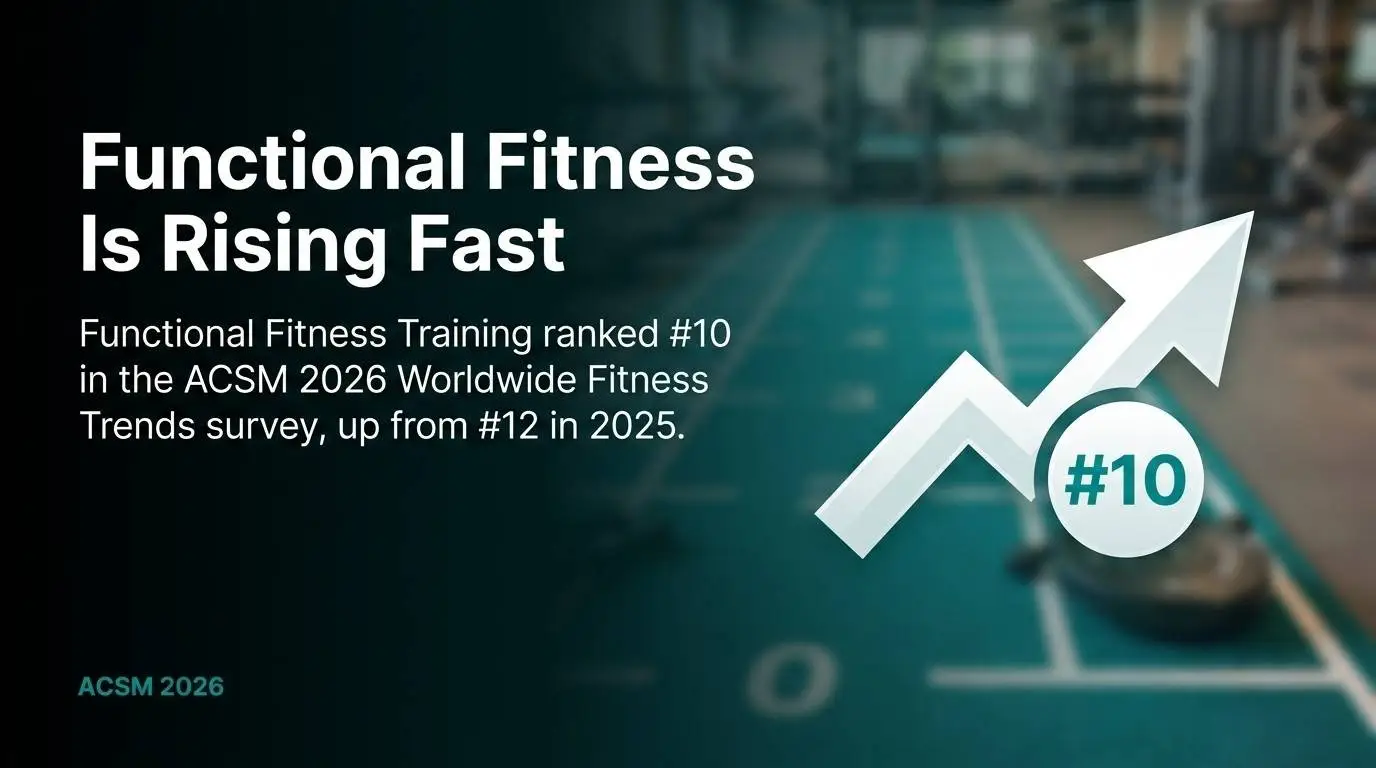
Functional Fitness Training ranked #10 in the ACSM 2026 Worldwide Fitness Trends survey, up from #12 in 2025, which tells you this approach is gaining ground fast among fitness professionals who want results that stick.
And honestly, that makes sense. Most clients don't care about their one-rep max on a leg press. They want to carry their groceries without throwing their back out. They want to climb stairs without getting winded.
They want to feel capable. That's what functional fitness training is actually about, and it's why trainers who build programs around it tend to get better long-term results and better client retention.
Functional fitness training is a training approach built around exercises that replicate the movements people perform in daily life, using the body's natural movement patterns to improve real-world strength and mobility.
The core idea comes from the SAID principle (Specific Adaptation to Imposed Demands), which means the body adapts to the specific demands placed on it. If you train movements that look like everyday life, you get better at everyday life.
If you train only isolated muscles on a fixed machine, you get better at that machine. The transfer to real-world activity is limited.
Functional training uses compound movements, meaning exercises that work multiple joints and multiple muscle groups at once. A squat isn't just a leg exercise.
It's a knee-focused, multi-joint movement that primarily requires anterior chain activation, core stability, glute activation, and ankle mobility, all occurring simultaneously. That's why it shows up in almost every functional training program.
The contrast with traditional bodybuilding-style training matters here. Traditional strength training often focuses on hypertrophy using isolation exercises (e.g., bicep curls, leg extensions), which build muscle volume effectively but don't necessarily teach the body to coordinate those muscles under real-world conditions.
Functional fitness training works across planes of motion, builds stability alongside strength, and demands more from the nervous system. That's a harder ask, and that's the point.
Functional fitness training and traditional strength training differ most significantly in their training objectives, not their tools. Both can use barbells, dumbbells, and bodyweight. The difference is in movement intent.
Traditional strength training tends to prioritize load and muscle isolation. You target a specific muscle, you move a weight, you rest. The goal is often hypertrophy or maximal strength in a single plane of motion. That's valid for plenty of goals. But it's not the full picture.
Functional training prioritizes movement quality, coordination, and transfer to daily function. A Romanian deadlift is a functional exercise because the hip hinge pattern it trains shows up every time a person bends over to pick something up. A push-up builds pressing strength, but it also demands core stability and shoulder girdle control in a way a chest press machine doesn't require.
The best programs for most clients blend both approaches. You don't have to abandon barbell training to go functional. You just need to ensure your clients are also training the movement patterns that matter outside the gym.
A well-structured program includes scheduled functional training sessions alongside other training goals, rather than treating it as an afterthought.
One more distinction worth naming: functional training isn't the same as CrossFit, though there's overlap.
CrossFit uses functional movements under high intensity. Functional fitness training, as a broader category, includes everything from a slow bodyweight squat with a 70-year-old client to a loaded kettlebell carry with an athlete. The movement patterns are the constant. The intensity and load vary by client.
Functional fitness training produces benefits that extend well beyond gym performance, directly improving how clients move, feel, and function in everyday life.
The benefits break down into six areas that are worth communicating clearly to your clients, because understanding the “why” is often what keeps them consistent.
Training movement patterns under controlled conditions builds the joint stability and muscle coordination that protects against injuries during real-world tasks. Clients who squat well in the gym are less likely to hurt their knees loading the dishwasher.
Functional exercises frequently challenge single-leg stability and require the body to manage forces across multiple planes, building the balance and coordination that traditional bilateral machine training doesn't develop.
Almost every functional exercise demands active core engagement because the spine must be stabilized when a load is applied in real-world positions. This builds genuine core stability, not just a strong “beach six-pack.”
When clients train the carry, lunge, push, and pull, those patterns become more efficient in daily life. Carrying luggage, climbing stairs, lifting children, all of it gets easier.
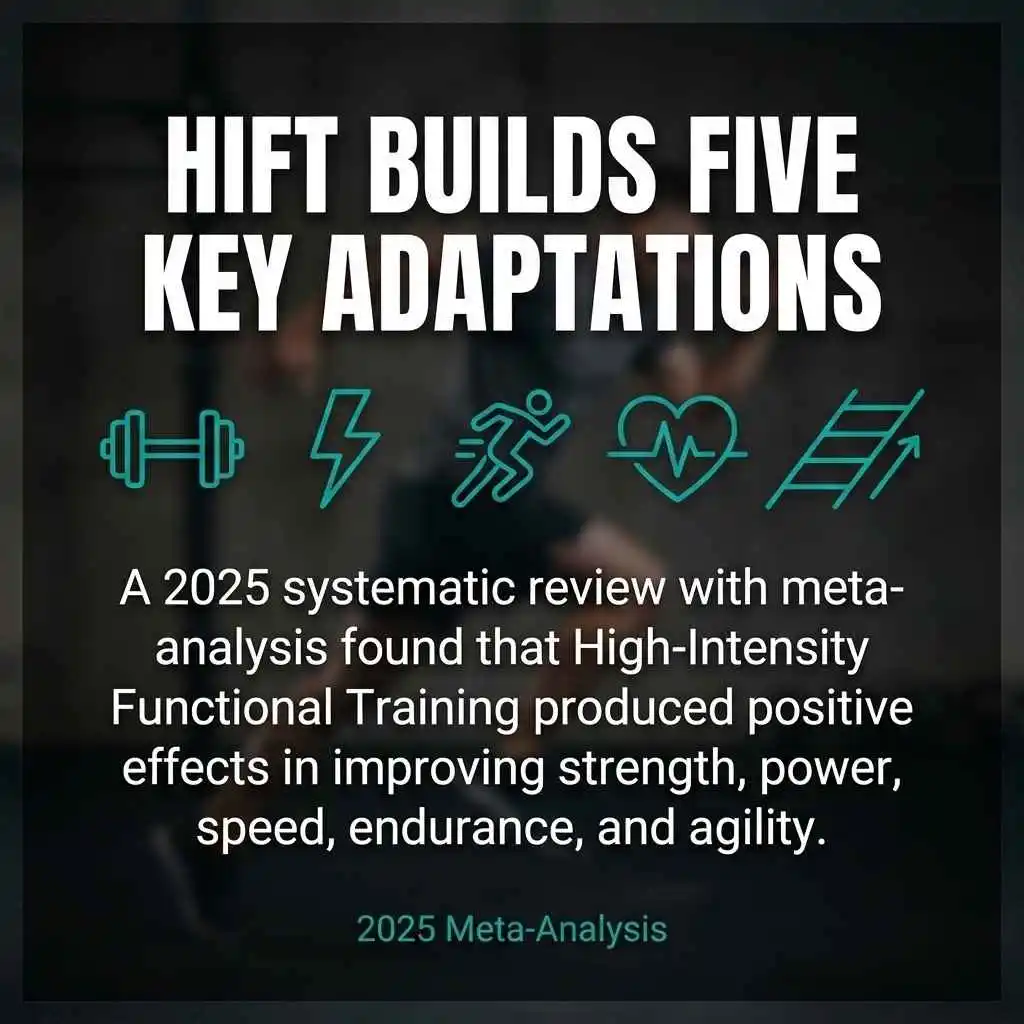
A 2025 systematic review and meta-analysis found that High-Intensity Functional Training (HIFT) had positive effects on strength, power, speed, endurance, and agility. That's a broad range of adaptations from one training style.
This is significant. A 2025 Frontiers in Medicine systematic review synthesizing 95 studies found that exercise interventions improved functional fitness in older adults aged 65 and older. For this population, functional training isn't just about fitness. It's about staying independent.
For trainers, these benefits are also selling points. Clients who feel functional improvements in their daily life stay in programs longer. That's good for them and good for your retention numbers.
Every effective functional fitness training program is built around seven foundational movement patterns that collectively cover how the human body moves in real life.
Memorize these seven. They're the framework for building any functional program, and they help you quickly audit whether your clients' current programs are complete or have gaps.
A knee-dominant movement that loads the quads, glutes, and hamstrings. It mirrors sitting, standing, and lowering to pick something up. Bodyweight squats, goblet squats, and barbell back squats all fall here.
A hip-dominant movement that trains the posterior chain. Deadlifts, Romanian deadlifts, and kettlebell swings are the key exercises. Every time someone bends over to pick something off the floor, they're performing a hinge.
A pressing movement in either a horizontal or vertical plane. Push-ups and dumbbell bench press are horizontal pushes. Overhead press is vertical. Both are needed because pushing up (overhead) and pushing away (forward) are common real-world demands.
The counterpart to the push, including horizontal rows and vertical pulls like chin-ups or lat pulldowns. Pulling patterns are frequently undertrained and essential for postural balance and shoulder health.
A single-leg movement that builds unilateral strength, stability, and coordination. Walking lunges, split squats, and step-ups belong here. Because most real-world movement is unilateral (walking, climbing stairs, stepping over obstacles), lunge patterns are non-negotiable in a complete functional program.
Rotational movements train the transverse plane, which is often the most neglected in traditional programs. Medicine ball throws, cable rotations, and rotational bodyweight movements develop the core's ability to transfer force across the body, which is fundamental to most athletic and daily movements.
Loaded carries (farmer's carries, suitcase carries, waiter's walks) are among the most underused and effective functional exercises available. They train grip, core stability, posture, and cardiovascular conditioning simultaneously. And they're directly analogous to real life. Picking up heavy bags and walking with them is a functional fitness training session in disguise.
A functional program that misses any of these seven movement patterns has a gap. Your job as a trainer is to make sure every client trains all seven, with progressions tailored to their ability level.
The ten exercises below cover all seven movement patterns and are appropriate across a range of ability levels, from beginners to more advanced trainees.
Hold a dumbbell or kettlebell at your chest with both hands. Stand with feet shoulder-width apart, toes slightly out. Lower until thighs are parallel to the floor, keeping your chest tall and knees tracking over your toes.
Drive through your heels to stand. This is an excellent beginner squat variation because the counterbalance makes it easier to maintain depth and posture. Start with 3 sets of 8-12 reps.
Stand holding dumbbells in front of your thighs. Hinge at the hips, pushing them back while keeping a neutral spine, until you feel a stretch in your hamstrings. Drive the hips forward to return to standing.
The RDL is the hinge pattern at its most accessible. It directly trains the posterior chain movement needed to lift anything from the floor safely. Start with 3 sets of 8-10 reps.
Set up a kettlebell about a foot in front of you. Hinge to grab it with both hands, hike it back between your legs, then drive the hips explosively forward to swing it to chest height. The power comes from the hips, not the arms.
The swing trains the hinge pattern under a power demand, which few exercises replicate as effectively. Start with 3 sets of 10-15 reps once the hinge pattern is solid.
Start in a high plank position with hands just outside shoulder-width. Lower your chest to the floor with a straight line from your shoulders to your toes, elbows at roughly 45 degrees to your torso.
Press back up. The push-up is one of the most functional upper body exercises because it demands core stability alongside pressing strength. Beginners can start from an elevated surface or from the knees. Progress to standard push-ups, then add a weighted vest or move to a single-arm variation.
Place one hand and one knee on a bench. Hold a dumbbell in the opposite hand, let it hang below your shoulder, then drive your elbow back toward your hip, keeping your torso stable. Lower with control.
Rows are the pull pattern most people need more of. Horizontal pulling strength is essential for postural health and shoulder balance in clients who spend most of their day hunched over a screen.
Stand with feet hip-width apart, holding dumbbells at shoulder height, palms forward. Press the weights overhead until your arms are fully extended, then lower with control. The overhead press trains the vertical push pattern and demands significant core stability to avoid overextending the lower back.
It's directly relevant to reaching and lifting overhead in everyday life.
Stand tall, then step one foot back and lower until both knees are at roughly 90 degrees. Drive through the front heel to return to standing.
The reverse lunge is often better than a forward lunge for beginners because it places less shear force on the knee and is easier to control. It trains single-leg strength, balance, and the lunge pattern that mirrors walking, climbing stairs, and stepping over obstacles.
Stand on one foot, hold a dumbbell in the opposite hand, then hinge forward while extending the non-standing leg behind you for balance. Return to standing by driving the hips forward.
This exercise combines the hinge pattern with significant balance demands, making it one of the best functional exercises for building unilateral stability.
Pick up a heavy dumbbell or kettlebell in each hand. Walk for a set distance or time, keeping your shoulders back, core braced, and posture tall. The farmer's carry might be the most underrated exercise in this list.
It trains grip, core stability, and posture under load, all at once, and it's exactly what carrying heavy bags of groceries demands from your body. Start with a distance of 20-30 meters and build from there.
Set a cable or resistance band at chest height. Stand sideways to the anchor point, hold the handle with both hands, then rotate your torso away from the anchor, keeping your arms relatively straight.
Return with control. Rotational core training is frequently missing from beginner programs, and this is the safest way to introduce it. It trains the transverse plane strength needed for any sport and most daily movements that involve twisting.
A functional fitness training program is built around the seven movement patterns, progressively loaded and structured to develop real-world strength and movement quality over time.
The choice between pre-made templates and bespoke programs matters here. For program design decisions, consider that templates work well when the movement patterns are correct, but individual clients will almost always need modifications based on their mobility, injury history, and goals.
Before prescribing a single exercise, assess your client's movement quality. Do they have the hip mobility for a squat? Can they hinge without rounding their lower back? Is there a shoulder issue that limits overhead pressing?
A solid fitness and lifestyle assessment tells you which movement patterns need work and which progressions are appropriate from day one. A structured client onboarding process makes sure that information is captured before the first session, not discovered mid-workout.
A complete functional program touches every pattern each week. That doesn't mean every pattern in every session. A three-day-per-week program might cover squat and push on day one, hinge and pull on day two, and lunge, rotate, and carry on day three. Or you can use full-body sessions that sample from each pattern every time.

Beginners start with bodyweight or light loads. Intermediate trainees add load, complexity, or instability. Advanced trainees layer in speed, power, or single-limb variations.
The progression should match the client's actual ability, not what looks impressive on paper. Tracking those training results over time is what lets you make smart progression decisions.
Functional fitness training doesn't require a fully equipped gym. Most of the ten exercises above can be done with dumbbells, kettlebells, or resistance bands. Bodyweight variations cover the squat, push, lunge, and rotate patterns entirely.
That makes functional training highly deliverable for online clients who train from home, which is a practical advantage worth communicating to prospective clients.
A three-day functional fitness training schedule provides most clients with enough volume to see meaningful progress while allowing adequate recovery time between sessions.
The schedule below suits a beginner-to-intermediate client. Each session covers multiple movement patterns and takes roughly 45-60 minutes, including warm-up and cool-down.
Movement patterns: Squat, Push
Example exercises: Goblet squat, Push-up, Reverse lunge
Movement patterns: Hinge, Pull
Example exercises: Romanian deadlift, Dumbbell row, Single-leg deadlift
Movement patterns: Lunge, Carry, Rotate
Example exercises: Walking lunge, Farmer's carry, Cable rotation, Kettlebell swing
Rest days aren't just passive recovery. Encourage clients to stay active with walking, stretching, or mobility work. Light movement on off days supports recovery without adding training stress.
For more advanced clients, four days per week allows you to increase volume without sacrificing recovery. A four-day split might pair push and lunge on two days, and hinge and pull on two others, with carries and rotation distributed across all sessions.
The frequency of functional training depends on the client's current fitness level and recovery capacity. Three days per week is a solid foundation for most adults.
Consistency across months matters far more than training five days per week for three weeks then burning out. Help clients see that. It's one of the foundational personal training principles that drive results.
Functional fitness training is appropriate for virtually every client population, but the programming priorities and exercise selection shift significantly depending on age, goals, and training history.
Beginners benefit enormously from functional training because it builds the movement quality they need before they add serious load. Start with bodyweight variations of each movement pattern.
A bodyweight squat before a goblet squat. A hip hinge with a dowel rod before a Romanian deadlift. Slow progressions let beginners build motor patterns correctly, which prevents compensations that can lead to injuries later.
The most common beginner mistake is skipping the foundational movement work and going straight to loaded exercises. That's where injuries start. Functional training for beginners is about movement quality first, load second.
This is where the case for functional training gets particularly strong. More than 25% of older adults fall each year in the U.S., and falls are the leading cause of injury-related death in persons aged 65 or older, according to CDC fall prevention data. That's one in four of your older clients at meaningful risk every year.

Functional resistance training can enhance motor performance, balance, and strength while reducing the risk of falls in older adults, according to research on functional resistance training.
Functional exercises to improve leg strength and balance are recommended as the first-line approach for fall prevention in older adult populations. That's not a minor benefit. That's a potentially life-saving intervention delivered through exercise programming.
Functional training pairs naturally with dedicated senior fitness programs available through Medicare Advantage plans and community organizations, giving older clients more than one route into consistent movement.
Athletes use functional training to transfer gym strength into sport performance. Rotational power work, single-leg stability under load, and explosive hinge patterns (kettlebell swings, trap bar jumps) all have direct carry-over to athletic demands.
For this population, functional training often serves as a bridge between traditional strength work and sport-specific conditioning.
The majority of your clients fall into this category. They work desk jobs. They have families. They want to feel less stiff, move better, and have more energy.
Functional fitness training is genuinely the best approach for this group because it builds the physical capacity they actually need for their actual lives. And when clients feel that transfer happening, when they realize the reverse lunges made climbing stairs easier, they buy in hard. That's the kind of result that keeps people training in the long term.
Three days per week is the standard starting point for most clients. This provides sufficient training stimulus to drive adaptation while allowing recovery time between sessions. More advanced clients can train four to five days per week by splitting movement patterns across more sessions.
No. Many of the most effective functional exercises are bodyweight-based. Squats, push-ups, reverse lunges, single-leg deadlifts, and rotational core work require no equipment. Dumbbells, kettlebells, and resistance bands significantly expand the options but aren't prerequisites.
There's significant overlap, but they're not the same thing. CrossFit uses functional movements performed at high intensity in a group setting. Functional fitness training is a broader training philosophy that can be applied at any intensity, for any population, in any setting. Not all functional training is high intensity, and not all high-intensity training is functional.
Yes, particularly in beginners and those returning to training. The compound, multi-joint nature of functional exercises produces significant muscle stimulus. For experienced trainees focused primarily on hypertrophy, functional training works best as a complement to targeted strength work rather than a complete replacement.
Most clients notice improvements in movement quality and daily function within four to six weeks of consistent training. Strength and body composition changes typically become visible over eight to twelve weeks. The real measure of success in functional training is how clients feel doing everyday tasks, and that often changes faster than the scale or the mirror.
Functional fitness training works because it makes the gym relevant to real life. When clients feel stronger carrying their kids, more stable climbing stairs, and less achy after a long day, they connect the dots between training and quality of life.
That connection is what drives long-term adherence, and long-term adherence is what produces real results.
As a trainer, your job is to design programs that cover the seven movement patterns, progress intelligently, and match your clients' actual goals and ability levels. Start with a proper baseline assessment. Build in all movement patterns. Track progress. Adjust as needed.
If you want to further deepen your expertise, pursuing functional training qualifications is a natural next step. And if you want to know how to plan and deliver those programs at scale, particularly for online clients, take a look at how scheduling client workouts effectively fits into the bigger picture of program delivery.
Ready to deliver functional fitness programs your clients can actually follow?
PT Distinction gives you everything you need to run your online and hybrid coaching business in one place, from program delivery and progress tracking to client communication and habit coaching. Start your free 1-Month trial and see why thousands of trainers worldwide trust PT Distinction to power their coaching.
Ready to join the family?
We'll get you up and running in no time. Start with our zero-risk free trial and build your personal training empire today.